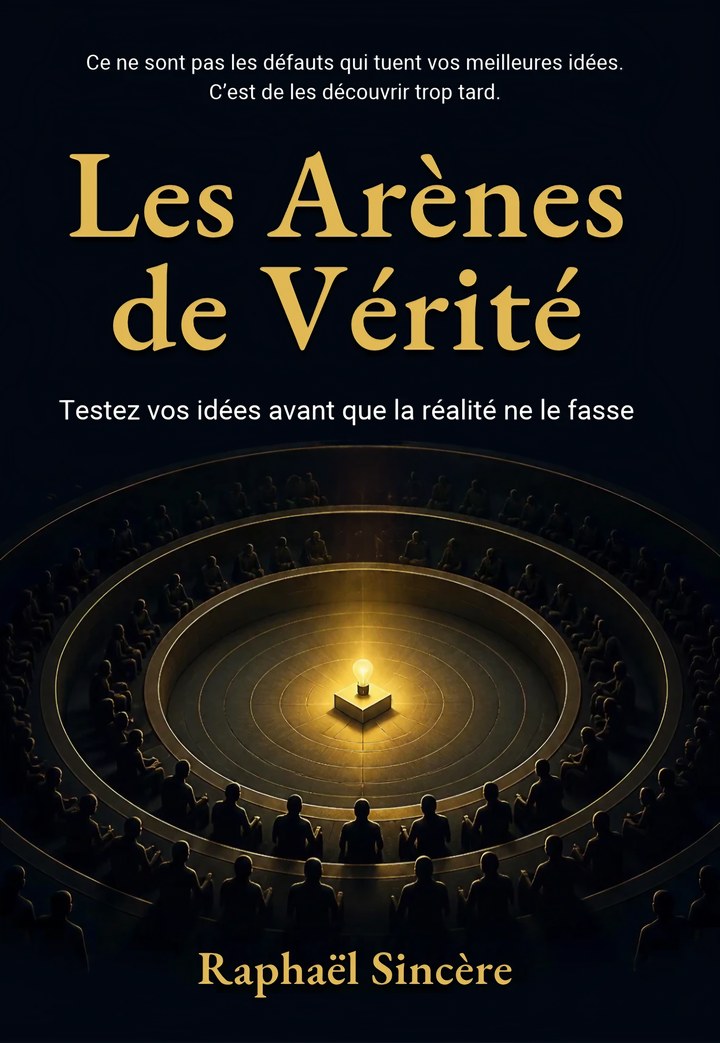
Before you publish, have your title, your cover, and your back cover copy read by readers with no interest in pleasing you: readers simulated by AI, one third of them skeptics, required to quote the exact sentence they’re criticizing.
My first book was a guide to love and relationships. Before publishing it, I asked an AI what it thought. A few months later, I asked the question differently.
The mirror
“What do you think?”
“9.1 out of 10. Publish right away.”
A single voice that knows you’re the author
Compliments, never the flaw
The Arena
A hundred simulated women readers, one third of them skeptics
“A man is explaining to me how to find love.”
The blocking criticism, quoted word for word
The text was about me, not about the reader
Same book. Same AI. It wasn’t the AI that had changed. It was the way I convened it.
Do It Now
The 5-Minute Experiment
Take a short text from your book: the back cover copy, the Amazon description, or the first paragraph. Then have the same text read in two ways.
The mirror. In a new conversation, paste your text and simply ask, “What do you think?” Note the answer.
The Arena. In another new conversation, copy the Arena prompt below and replace [PASTE HERE] with the same text. Don’t say it’s yours.
Compare. What did the second answer see that the first one missed? Before you believe a criticism, check that the quoted sentence actually appears in your text (Ctrl+F, or Cmd+F on a Mac).
The Calibrated Arena
Chapter 3 · For a short text
Submit this text to a Market Arena of 10 readers from its target audience,
to assess what would make them lose interest or have doubts.
At least one third are skeptical or in a hurry.
Rules:
1. Each reader quotes the exact sentence that bothers them.
   Any criticism without an exact quote is discarded.
2. Each criticism is rated: BLOCKER, MAJOR, or MINOR.
3. Add a Defender who flags exaggerated or unfair criticism.
4. No percentages, no scores: reasons.
5. Mark every fact you state with [TO VERIFY].
Report:
1. AGREEMENT — blocking criticisms raised by several readers
2. DISAGREEMENT — what divides the readers, and why
3. WHAT HOLDS UP — 2 passages to leave untouched
4. IMPROVEMENTS — one rewrite per blocking criticism, offered as an option
5. REALITY CHECK — 3 questions to ask real readers
Here is the text: [PASTE HERE]
Three Precautions
A new conversation for each Arena, preferably in temporary or private mode if your text is unpublished.
Never say the text is yours: when it knows it’s talking to the author, AI holds back.
Criticisms are hypotheses. The real answers come from real readers.
Before Release
Three Moments That Make or Break a Book
A reader decides in a few seconds: a title, a cover, a few lines on the back. That’s where an Arena pays off the most.
The title
Does every reader hear the same promise?
Compare two or three titles. What to look for: the gap between the promise you meant to make and the one readers hear. A title that each segment sums up differently hasn’t found its promise yet.
The Arena prompt for comparing your titles is in Chapter 21.
The cover
What do people understand in two seconds?
My first cover showed golden dunes under a midnight-blue sky and, in the center, a compass whose needle circled a heart. Everyone thought it was beautiful. Next to competing books, it said something else: a desert, a compass, an adventure novel. The heart was visible only up close. I redid it. Several times.
The Arena prompt for a visual, and how to check what the AI claims to see: Chapter 13.
The Back Cover Copy
Which sentence makes people buy, and which makes them put the book back?
What to look for: the sentence that talks about you instead of the reader, and the promise the book doesn’t keep—the one a disappointed reader would quote in a review. The sentence several profiles repeat spontaneously is often your best hook.
The Arena prompt, and the Arena that hunts down the promise too far, are in Chapter 21.
And the Rest of the Book?
The Arena prompts are in the book.
The Author chapter gives you the Arena prompts for the title and the back cover, plus the manuscript Arena, chapter by chapter, the launch-plan Arena, and a typical sequence from title to release. The whole book gives you six Arenas for every question a project raises, and the rules that keep the AI from flattering you or making things up.
Its title, its tagline, and its cover went through its own Arenas. Inside, you’ll find the six Arenas, ready-to-use Arenas by profession—including a whole chapter for authors—and a toolkit reserved for readers.